


CIPN clinical evidence
Cryocompression is a safe, tolerable, and effective method of CIPN management
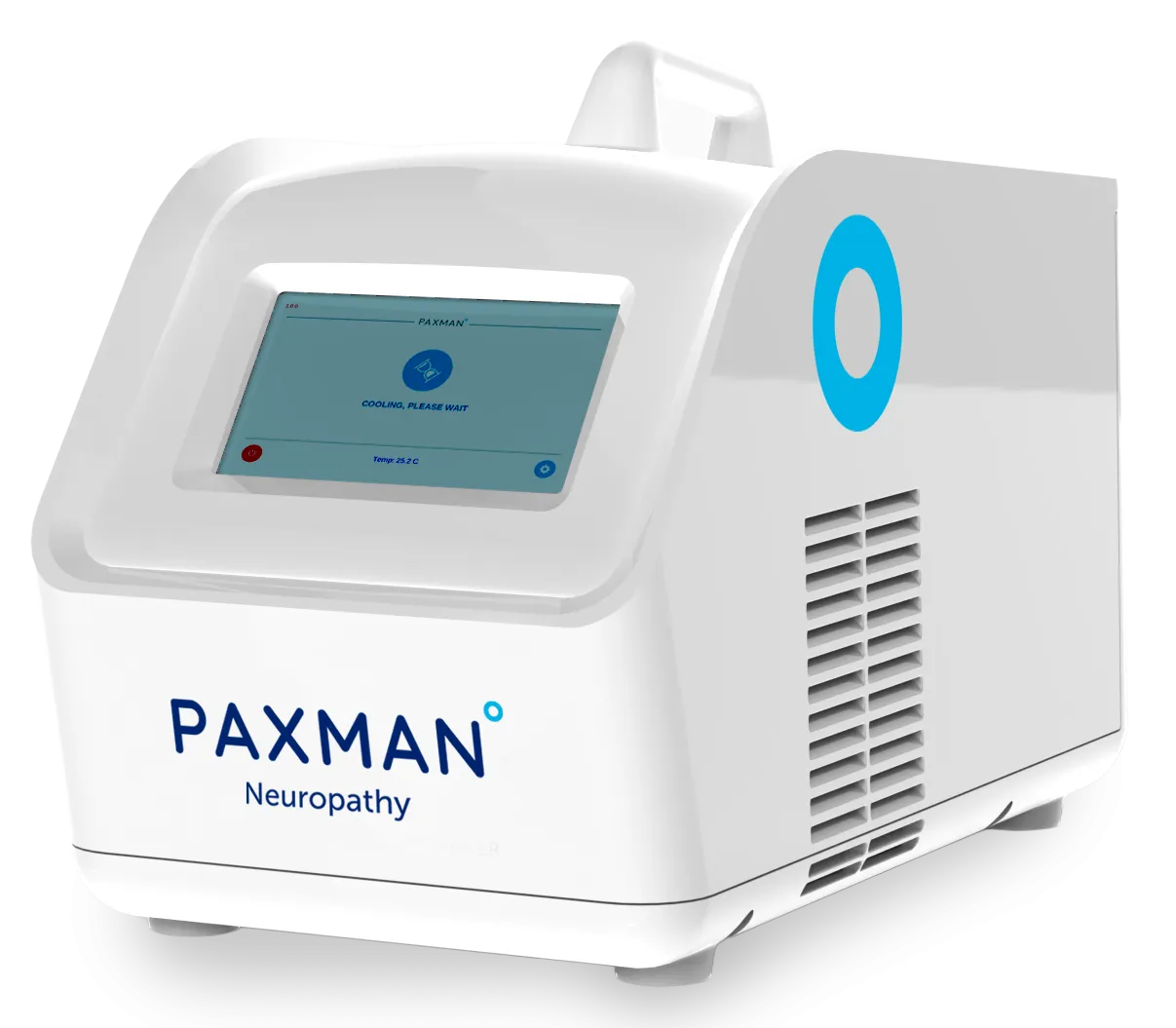
The Paxman Neuropathy System offers a 95% relative reduction of risk in incidence of any-grade CIPN versus historical untreated controls, and 70% for any-grade CIPN*. It represents reduction of higher-grade neuropathy that would otherwise require intervention or chemotherapy dose modification.
From biological insight to clinical benefit
The Paxman Neuropathy System is supported by the following clinical evidence of efficacy, safety, and tolerability of cryocompression during taxane-based chemotherapy in 150 patients from a single-arm phase II study.1
relative risk reduction in incidence of NCI CTCAE grade ≥2 CIPN versus historical untreated controls
relative risk reduction in incidence of any-grade CIPN versus historical untreated controls
Efficacy
Physician-assessed CIPN after use with the Paxman Neuropathy
- At 12 weeks, Grade 2 CIPN or higher was reported in 1.6% of patients
- 75.6% of patients were assessed with no CIPN
- Any-grade CIPN was reported in approximately 24.4% of patients
- No Grade 3 or 4 CIPN was reported
CIPN severity was graded using National Cancer Institute (NCI) CTCAE grading. CTCAE grade 2 is especially relevant because it reflects symptoms that interfere with instrumental activities of daily living and may influence treatment decisions.
| Grade 0 | 75.60% |
|---|---|
| Grade 1 | 22.80% |
| Grade 2 | 1.60% |
| Grade 3/4 | 0% |
Patient-reported CIPN at 12 and 24 weeks
Patient-reported outcomes were available in 115/123 patients (93.5%) at 12 weeks and 107/123 (87.0%) at 24 weeks.
| Time point | Clinically significant CIPN | No CIPN |
|---|---|---|
| 12 weeks | 13.9% | 86.1% |
| 24 weeks | 13.1% | 86.9% |
Dose Modification
Safety & Tolerability
The Paxman Neuropathy was found to be safe and well-tolerated in patients receiving taxane-based chemotherapy. Moreover, it can be safely administered in conjunction with scalp cooling therapy.
found the Paxman Neuropathy System tolerable
withdrew due to cold intolerance, demonstrating that cryocompression was well-tolerated at 11°C
had incidences of core hypothermia, frostbite or higher-grade cold-related adverse events
Concurrent scalp cooling did not affect cryocompression
The Paxman Neuropathy System safely and tolerably provides clinically relevant results, demonstrating efficacy in reducing CIPN symptoms that interfere with instrumental activities of daily living and influence treatment decisions.
An advantage over traditional CIPN prevention methods
Compared to frozen gloves and cooling alone, cryocompression demonstrated lower tolerable temperatures over time in a comparison study.2
Continuous-flow cooling and cryocompression achieved relatively even cooling profiles of the hand whereas, frozen gloves tended to cause “cold spots” which could be a reason for intolerance and frostbites over longer exposure times.
Cryocompression has emerged as one of the most promising, reproducible, and standardised approaches to CIPN management, potentially by reducing neurotoxic chemotherapeutic delivery to peripheral nerves through vasoconstriction and decreased metabolism, as evidenced by several studies and outlined in the clinical guidelines of ASCO3, ESMO4, and NCCN5.

Cryocompression

Continuous-flow cooling

Frozen gloves

The Paxman Neuropathy System Clinical Evidence Brochure
CIPN is a common, persistent and burdensome side effect of chemotherapy and can influence treatment delivery. The Paxman Neuropathy offers a clinically supported approach to managing it. Download the clinical brochure for more information.

Clinical studies library
Explore a comprehensive library of more than 100 clinical studies focused on chemotherapy side effect management. From landmark scalp cooling clinical trials to the latest research on CIPN intervention, access the data shaping the future of oncology care.
Review the science, evaluate the outcomes, and inform your clinical decisions with confidence.
The science behind CIPN management
Did you know that chemotherapy-induced peripheral neuropathy doesn’t occur from a single mechanism? Did you know that cooling exerts a number of biological effects to protect the nerves? Find out how CIPN develops and how cooling and compression combined can help reduce it.
References
- Wong, R., Bandla A., “Limb Cryocompression for Prevention of Taxane-Induced Peripheral Neuropathy: A Phase II Study and a Randomized Phase III Trial,” Presentation, MASCC/ISOO Annual Meeting, Melbourne, Australia, 2026.
- A. Bandla et al., “Limb Hypothermia for the Prevention of Chemotherapy-Induced Peripheral Neuropathy – Modality for Optimal Cooling,” 2020 42nd Annual International Conference of the IEEE Engineering in Medicine & Biology Society (EMBC), Montreal, QC, Canada, 2020, pp. 5061-5064, doi: 10.1109/EMBC44109.2020.9175432.
- Charles L. Loprinzi et al.Prevention and Management of Chemotherapy-Induced Peripheral Neuropathy in Survivors of Adult Cancers: ASCO Guideline Update. J Clin Oncol 38, 3325-3348(2020). DOI:10.1200/JCO.20.01399
- Jordan B, Margulies A, Cardoso F …Systemic anticancer therapy-induced peripheral and central neurotoxicity: ESMO–EONS–EANO Clinical Practice Guidelines for diagnosis, prevention, treatment and follow-up. Annals of Oncology, 2020; 31, 1306-1319
- Gradishar WJ, Moran MS, Abraham J, Abramson V, Aft R, Agnese D, Allison KH, Anderson B, Bailey J, Burstein HJ, Chen N, Chew H, Dang C, Elias AD, Giordano SH, Goetz MP, Jankowitz RC, Javid SH, Krishnamurthy J, Leitch AM, Lyons J, McCloskey S, McShane M, Mortimer J, Patel SA, Rosenberger LH, Rugo HS, Santa-Maria CA, Schneider BP, Smith ML, Soliman H, Stringer-Reasor EM, Telli ML, Wei M, Wisinski KB, Yellala A, Yeung KT, Young JS, Schonfeld R, Kumar R. NCCN Guidelines® Insights: Breast Cancer, Version 5.2025. J Natl Compr Canc Netw. 2025 Nov;23(11):426-436. doi: 10.6004/jnccn.2025.0053. PMID: 41213254.
