


Chemotherapy-induced peripheral neuropathy (CIPN) remains one of oncology’s most difficult side-effect management challenges, affecting an estimated 30-90% of patients globally and an estimated 3 million cancer patients worldwide each year [1, 2, 3]. It is a common, potentially debilitating, and often persistent side-effect, which typically affects the sensory nerves of the hands and feet in a glove-and-stocking distribution. Symptoms can arise during chemotherapy, continue throughout, or even present themselves long after chemotherapy has completed.
For patients that develop the condition, this can mean experiencing anything from numbness, tingling and burning pain to electric shock-like sensations, altered temperature perception, and loss of dexterity. Weakness, balance impairment, and gait instability are also a risk. However, patients are often not aware of CIPN until chemotherapy is prescribed and may even be unaware of the chronic risk.
But what makes it such a pressing issue in oncology?
Thankfully, data suggests that cancer survivorship is increasing, not just due to growth and aging of the population, but advances in early detection and treatment [4]. However, this means more patients must navigate life with the side effects of chemotherapy, including CIPN.
Meta-analysis data by Seretny et al. found that prevalence of CIPN within the first month after chemotherapy was a 68.1%. This figure remained high at 60% after three months and persisted in 30% of patients at six months or longer [2].
Alongside the lack of effective prevention options and absence of effective pharmacological treatment, the devastating impact it has on these patients and healthcare systems mean that management of CIPN has become a large, unmet clinical need.
How chemotherapy causes peripheral neuropathy
For a long time, the mechanisms behind chemotherapy-induced peripheral neuropathy were unknown or merely hypothesised. Researchers and oncologists only knew which classes of chemotherapy drugs were potentially neurotoxic, without understanding how each of these drugs interact with the peripheral nervous system.
The chemotherapy classes most commonly associated with CIPN include taxanes, platinum agents, proteasome inhibitors, vinca alkaloids, immunomodulatory agents and antibody-drug conjugates with tubulin-binding payloads. Incidence ranges vary widely by agent, cumulative exposure, baseline risk and assessment method, with taxanes, platinum-based therapies and several newer targeted payloads all contributing to the ongoing clinical burden [2, 5].
Biologically, CIPN is complex. Peripheral nerves are particularly vulnerable because they are long, metabolically demanding cells; the dorsal root ganglia have relatively limited protection from circulating toxins; and healthy nerve function depends on mitochondrial energy production, axonal transport and normal signalling.
New research published in 2026 [6] has helped to ascertain certain disease mechanisms behind various neurotoxic chemotherapy agents and the different forms of cellular injury involved:
- Cell damage and stress: many chemotherapy agents reduce energy production in cells and increase oxidative stress. This damages the nerve cells and contributes to nerve dysfunction.
- Impaired axonal transport: taxanes and vinca alkaloids disrupt the transport of nutrients and cellular components along the nerve fibres. This weakens nerve function and contributes to damage within cells.
- Disruption of normal nerve signalling: chemotherapy can increase nerve sensitivity and cause abnormal sensory signalling. This contributes to symptoms such as tingling, burning pain, pain from light touch, and cold hypersensitivity.
- Neuroinflammation: chemotherapy activates inflammatory responses that sensitise nerves and may contribute to persistent neuropathic pain.
- Axon degeneration: agents such as taxanes and antibody-drug conjugates can cause progressive degeneration of axons, responsible for carrying electrical signals within the body.
This makes prevention clinically important: once nerve damage is established, reversibility can be uncertain and symptoms may persist into long-term survivorship.
How does CIPN impact survivorship?
The burden of CIPN – chronic in particular – is not limited to the treatment chair’s immediate symptoms and may persist indefinitely. Living with nerve damage from any one of the aforementioned mechanisms presents a multi-faceted survivorship issue with physical, psychological, and occupational consequences particularly for those who develop it chronically.
For example, sensory loss and balance impairment can lead to an increased likelihood of injury. It is plausible that the longer someone lives with CIPN, the more likely there is a risk. It has been reported that patients who develop CIPN are approximately 3 times more likely to fall and suffer from fall related injuries [7].
Psychologically, patients may feel fear and anxiety around their symptoms, depending on how it affects their life. [8] Difficulties at work for example may contribute to this psychological stress, losing an average of over 50 workdays [9], encountering hostile behaviours, and experiencing career change or loss [8].
Additionally, CIPN sufferers may require more healthcare contact after chemotherapy to manage their symptoms, whilst losing confidence in daily activities, and both may remain affected years after their cancer treatment has ended.
Assessment often combines clinician grading, such as NCI Common Terminology Criteria for Adverse Events (CTCAE), with patient-reported tools such as EORTC QLQ-CIPN20, as functional impact may be underestimated if only clinician-assessed toxicity is recorded.
The CTCAE grades for peripheral neuropathy range from asymptomatic (grade 1) to life threatening consequences (grade 4), with grade 5 indicating death [10]. Grade 2 CIPN is especially relevant because it indicates that symptoms begin to interfere with instrumental activities of daily living and can influence treatment decisions.
| National Cancer Institute – Common Terminology Criteria for Adverse Events (CTCAE) | ||||
| Grade 1 (Mild) | Grade 2 (Moderate) | Grade 3 (Severe) | Grade 4 (Life-threatening) | Grade 5 (Death) |
| Asymptomatic; clinical or diagnostic observations only; intervention not indicated. Mild pain. Tingling and/or numbness may be experienced. No functional impairment. |
Moderate symptoms that become more persistent; limiting instrumental activities of daily living (IADLs) e.g., preparing meals, shopping, using a mobile. Moderate pain. |
Severe symptoms; limiting self-care activities of daily living (ADLs) e.g., bathing, dressing, feeding self, using the toilet, taking medications. Severe pain. |
Life-threatening symptoms and consequences; urgent medical intervention indicated. Permanent disability risk. | Symptoms so severe they lead to death. |
CIPN has healthcare implications too
The impact of CIPN doesn’t just touch patients. For clinicians, it can create a difficult treatment dilemma: continue neurotoxic chemotherapy and risk worsening long-term toxicity, or consider delays, dose reduction, regimen modification or treatment discontinuation. The latter option may impact treatment effectiveness or even survival. It’s a decision that can weigh heavily on oncology professionals.
Moreover, the increase in patient healthcare contact may apply increased strain on finances and operations that would not be required were an effective prevention method to be implemented. One study showed that average healthcare costs for people suffering from CIPN are much higher at $17,344 USD [9]. While this bill may be footed by insurance payers or even patients themselves in the US, elsewhere, this additional cost could already have implications for healthcare systems such as the NHS.
Prevention is better than the cure
Pharmacological interventions or attempts to cure CIPN have provided little success, which is why a focus on prevention strategies are not a new concept.
Frozen gloves and socks, ice bags, cold packs, tight surgical gloves and compression garments have all been explored as ways to reduce chemotherapy exposure in the extremities, through the established mechanism of vasoconstriction.
Compression methods rely on physically restricting blood flow to the extremities. In a study by Kanbayashi, et al., a significant association was found between the use of surgical gloves (compression therapy) and a reduced incidence of CIPN [11].
Meanwhile, cooling exerts its protective effects biologically to achieve vasoconstriction, already evidenced by decades of scalp cooling research. Further studies in hair follicle cells have identified additional mechanisms by which cooling may provide biological cytoprotective effects [12]. The greater clinical adoption and evidence base for scalp cooling, compared with historical interventions such as head tourniquets that relied primarily on mechanical compression, suggest that biologically mediated cooling may be a more effective and practical strategy for reducing chemotherapy toxicity.
It is hypothesised that cooling can also provide additional cellular-level effects beyond vasoconstriction and while cryotherapy has already proven successful in reducing the incidence of CIPN [13], research is currently underway to understand these mechanisms further.
Chemotherapy decisions already require a careful balance between cancer control, tolerability and patient preference. When CIPN begins to interfere with function, clinicians may need to consider dose delay, dose reduction, substitution or cessation. Patients may also make decisions based on whether they believe symptoms are temporary or permanent. Prevention therefore offers value at several levels: preserving daily function, supporting chemotherapy adherence, reducing downstream healthcare utilisation, and improving the survivorship experience.
The prevention gap: why current prevention methods fall short
The problem with these historical approaches, however, is that they are variable and poorly controlled. Frozen gloves and/or ice bags risk excessive cold exposure and demonstrate inconsistent tolerability, whereas the level of compression from garments can vary between patients due to the fit. Both methods lack standardised protocols and apply an additional nursing burden. These constraints may reduce adherence and make results difficult to replicate consistently in real-world practice.
These limitations have created a need for more controlled technologies; prevention strategies that are tolerable, reproducible, and standardised, to help preserve chemotherapy dose intensity while reducing long-term neuropathy burden.
Introducing cryocompression
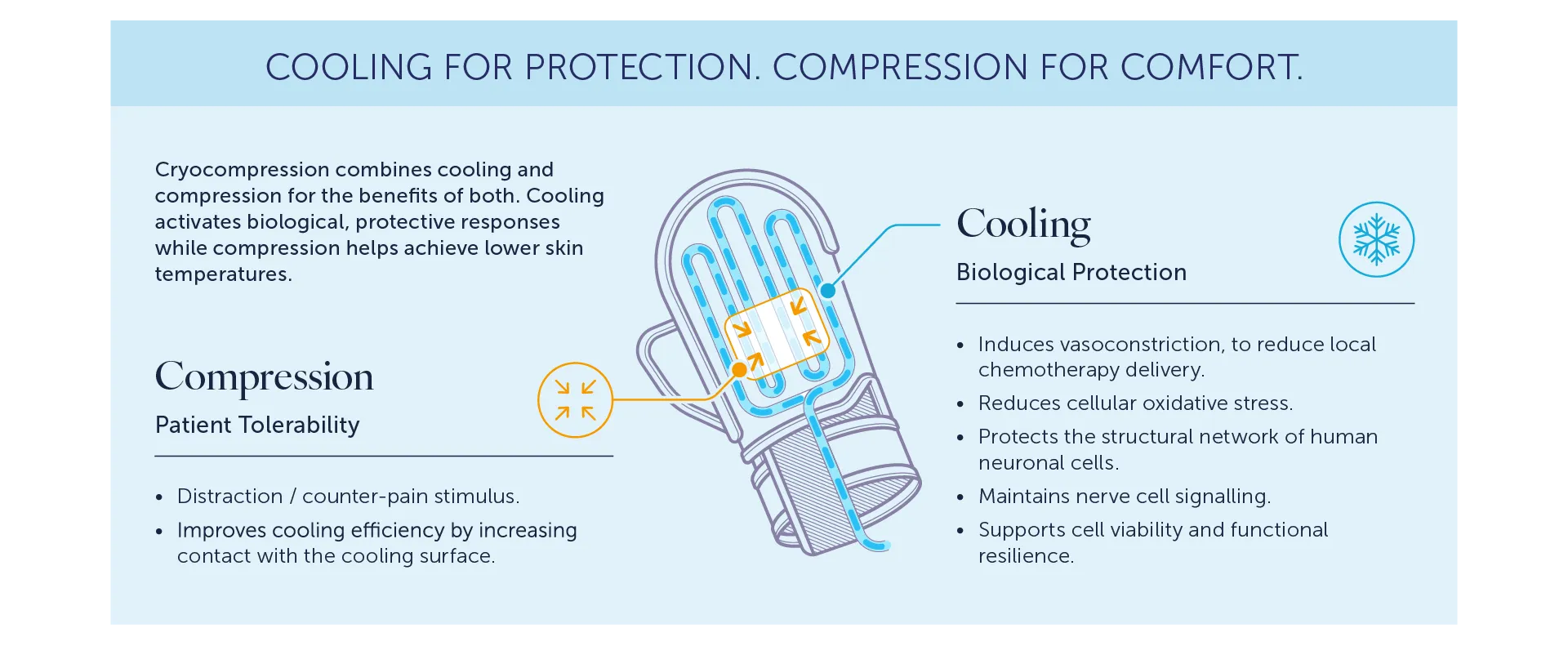
Cryocompression is designed to address the prevention gap by combining controlled cooling with cyclic compression.
Cooling aims to reduce local chemotherapy delivery to the hands and feet by activating the protective biological responses at the cellular level, including vasoconstriction.
Compression improves contact with the cooling surface and aims to improve tolerability through a counter-stimulus or massaging sensation. The idea is simple: cooling for biological protection, compression for patient comfort.
Cryocompression – achieved by a continuous-flow cooling system applying rhythmic pressure to the extremities – has demonstrated lower tolerable temperatures over time compared to commonly used frozen gloves and continuous-flow cooling alone [14].
A comparison study by Bandla et al. compared cryocompression intervention to frozen gloves and a continuous-flow cooling device. In the study, continuous-flow cooling and cryocompression achieved relatively even cooling profiles of the hand whereas frozen gloves tended to cause “cold spots” which could be a reason for intolerance and frostbites over longer exposure times [14].

Frozen Gloves

Continuous-flow cooling

Cryocompression
Cryocompression was capable of achieving the low temperatures of the frozen gloves, but with the even cooling profile and controlled delivery of the continuous-flow system. Moreover, the cryocompression device demonstrated the highest tolerability levels of the three interventions.
The Paxman Neuropathy System
The Paxman Neuropathy System has been developed as a dedicated cryocompression technology for CIPN management, capable of cooling hands and feet simultaneously.
Combining a compact refrigeration unit, gloves and boots for the extremities, compression modules, and a bespoke coolant, the system is able to administer controlled cooling and cyclic compression to the hands and feet during chemotherapy.
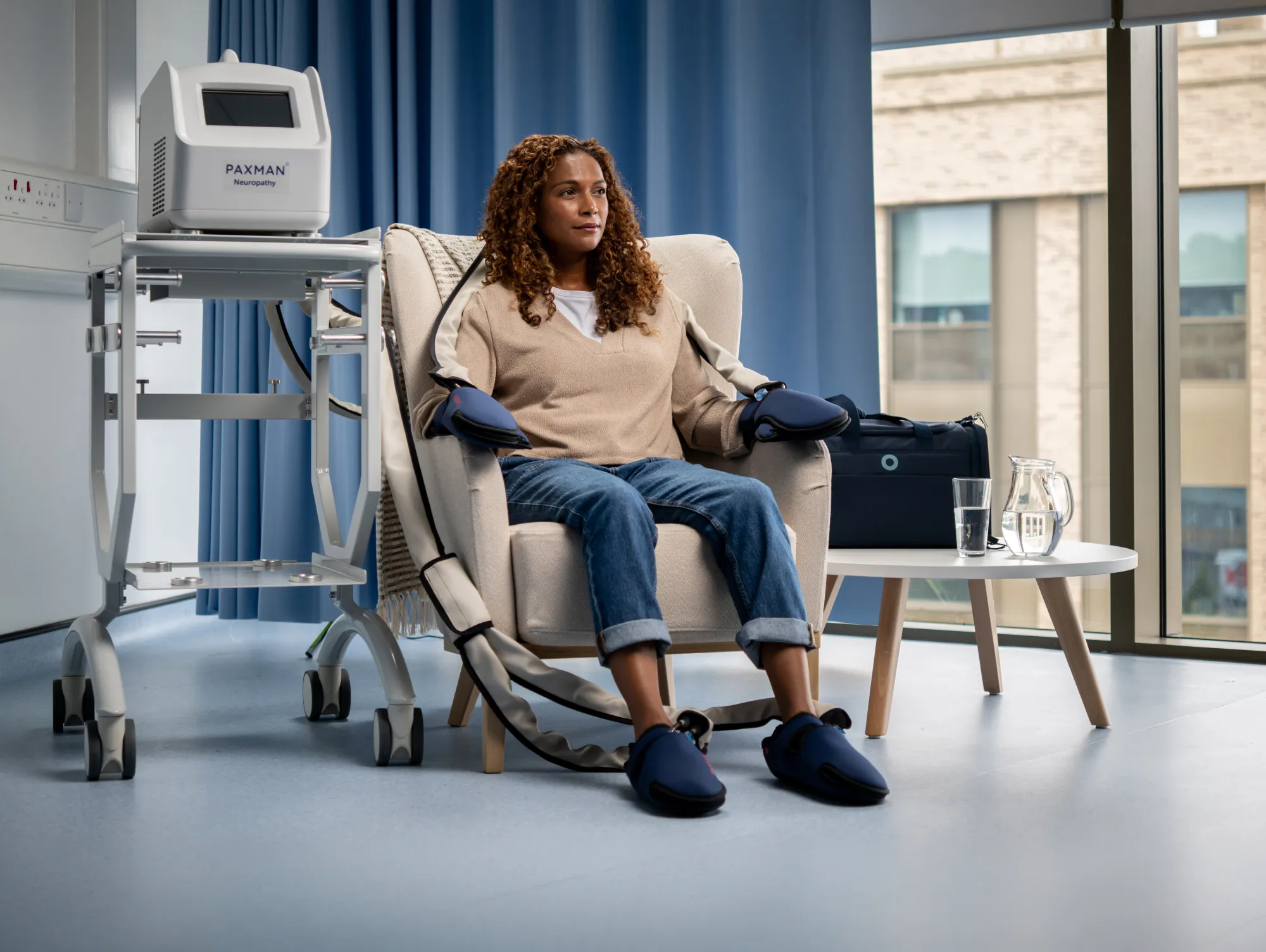
The benefit of a dedicated cryocompression system is its ability offer a standardised, reproducible approach, with consistent cooling coverage at tolerable levels. Practicality is also a key consideration to facilitate easier adoption and improve nursing burden levels associated with other prevention methods.
Evidence base: biological rationale and clinical results
Paxman’s research programme has had a three-pronged approach. Biologically, the work has focused on understanding how chemotherapy damages peripheral nerves and how controlled cooling may protect them.
Research undertaken alongside Sheffield Hallam University into these areas suggests neuroprotection is temperature-dependent, with optimal neuroprotection identified between 20–24°C.
With compression enhancing contact and supporting tolerability, the cooling element of the technology is believed to tackle the established disease mechanisms by:
- inducing vasoconstriction to reduce local chemotherapy delivery
- suppressing cellular oxidative stress
- preserving structural integrity of the neuronal cells
- maintaining nerve cell signalling
- and supporting cell viability and functional resilience.
Clinically, a single-arm phase II study in patients receiving taxane-based chemotherapy was conducted in Singapore to assess the efficacy, safety, and tolerability of the cryocompression device [15]. Data was compared to historical untreated controls and claims the device offers a 95% relative reduction in risk of NCI CTCAE grade 2 or higher CIPN, with a relative risk reduction of 75% in any-grade CIPN.
Outcomes from the study were obtained via both physician and patient-assessed methods. 75.6% of patients were physician-assessed with no CIPN at 12 weeks post-chemotherapy, while grade 2 or higher CIPN was assessed in 1.6%. Only 5.7% of patients required taxane dose reduction due to CIPN [15].
Patient-assessed results using EORTC QLQ-CIPN20 showed clinically meaningful CIPN in 14% of patients at 12 weeks and in 13% at 24 weeks [15].
The cryocompression system was found to be safe and tolerable. 84% of patients found the overall treatment tolerable, with 9 in 10 patients tolerating the cold temperatures. There were no instances of core hypothermia, frostbite or higher-grade cold-related adverse events, aside from reversible transient erythema [15].
These findings are clinically encouraging for CIPN management and are supported by biological rationale. As the study presents single-arm data compared to historical controls, further clinical trials are already underway in the United States to confirm effectiveness, comparative benefit, optimal protocols and generalisability across regimens and tumour groups.
Implications for clinical services
For clinical services, the potential value of CIPN management extends across patient experience, treatment delivery and resource use.
CIPN should no longer be viewed solely through the lens of symptom management after nerve damage has occurred. It is also a treatment-delivery, survivorship and quality-of-life issue. If controlled cryocompression can reduce clinically meaningful neuropathy, it may help services preserve chemotherapy dose intensity, avoid neuropathy-related dose changes, support patient independence and reduce the long-term burden of chronic toxicity.
By combining the emerging biological protective mechanisms of cooling with patient tolerability and workflow-conscious design, the Paxman Neuropathy System may create a shift towards proactive prevention. For nurses and service managers, the practical question is whether it can be delivered reliably without adding excessive workload – an implementation challenge the system is designed to address. Although further randomised evidence is needed and underway, the biological rationale and early clinical data suggest that cryocompression could become an important part of chemotherapy side-effect management, helping services protect patients from both cancer and the long-term consequences of its treatment.
